
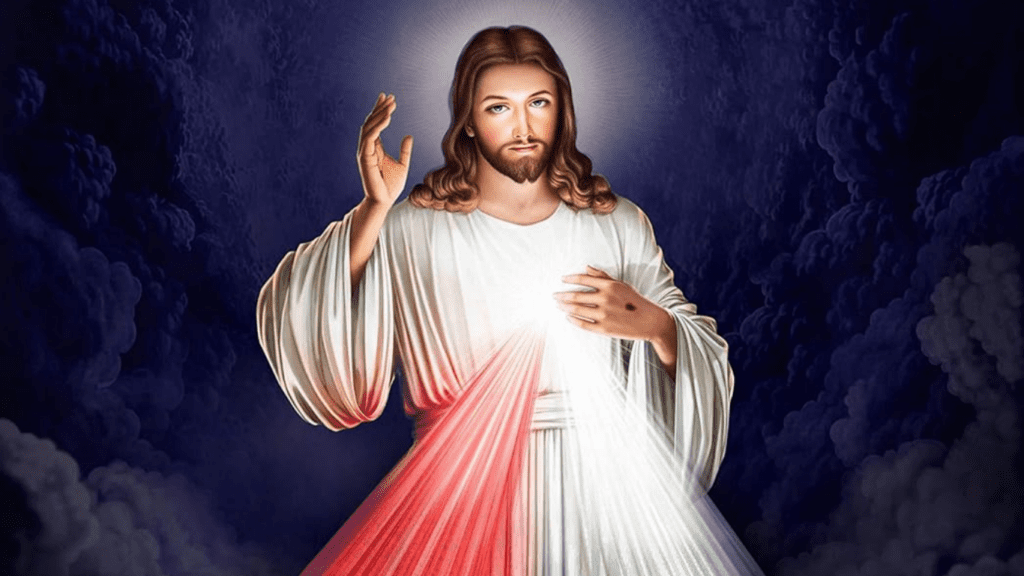
What is Divine Mercy?
Divine Mercy is the infinite love and compassion of God poured out for every sinner and every suffering heart. It reminds us that no matter how far we have fallen, God’s mercy is greater than our sin. Revealed most fully in Jesus Christ—especially in His Passion, Death, and Resurrection—Divine Mercy is an invitation to trust in Him and to extend that same mercy to others.
“The greater the sinner, the greater the right he has to My mercy. My mercy is confirmed in every work of My hands. He who trusts in My mercy will not perish, for all his affairs are Mine, and his enemies will be shattered at the base of My footstool.” (Diary, 723)
Origin of the Devotion:
On February 22, 1931, Jesus appeared to St. Faustina Kowalska, a religious sister in Poland, and asked her to paint his image as he appeared to her: in a white garment with two streams of light, one red and one white, coming from his heart with the signature “Jesus, I trust in You.” The painting was commissioned in 1934, and we now have what is known as the Divine Mercy Image.
Through his 14 visitations to St. Faustina, Jesus established veneration and devotion to his Divine Mercy, including:
The Feast of Mercy (Divine Mercy Sunday):
On the first Sunday after Easter, Jesus requested that his Divine Mercy image be solemnly blessed and that Sunday would be known as the Feast of Mercy. Jesus promised complete forgiveness of sins for the soul that venerates the Divine Mercy image, confesses one’s sins, and receives Holy Communion on the Feast of His Mercy.
The Divine Mercy Chaplet and Novena:
Jesus also dictated to St. Faustina the Chaplet of Divine Mercy, which can be recited as a 9-day novena leading up to Divine Mercy Sunday or at any time. Jesus promises immeasurable graces to souls who are devoted to reciting the Divine Mercy prayers:
“Say unceasingly the Chaplet that I have taught you. Whoever will recite it, they will receive great mercy at the hour of death. Priests will recommend it to sinners as their last hope of salvation. Even if there were a sinner most hardened, if he were to recite this chaplet only once, he would receive grace from My infinite mercy.” (Diary, 687)
The Hour of Mercy:
Our Lord asked for a special prayer and meditation on His Passion each afternoon at the three o’clock hour, the hour that recalls His death on the cross:
“At three o’clock, implore My mercy, especially for sinners; and, if only for a brief moment, immerse yourself in My Passion, particularly in My abandonment at the moment of agony. This is the hour of great mercy. In this hour, I will refuse nothing to the soul that makes a request of Me in virtue of My Passion.” (Diary, 1320).
Jesus emphasized to St. Faustina his great desire for devotion to His Divine Mercy to be spread throughout the whole world and that every soul come to know about the immeasurable depths of his Mercy.
“Oh, what great graces I will grant to souls who say this Chaplet. Write down these words, my daughter. Speak to the world about My mercy; let all mankind recognise my unfathomable mercy.” (Diary, 848)
You can learn more about Jesus’ Divine Mercy and his promises in St. Faustina’s Diary, Divine Mercy in My Soul, as well as other online resources, including:
What Is Divine Mercy Sunday and Why Is It So Important?
usccb.org/prolife/divine-mercy-sunday
The Promises of Jesus to those who Pray the Chaplet
17 Things Jesus Revealed to St Faustina About Divine Mercy